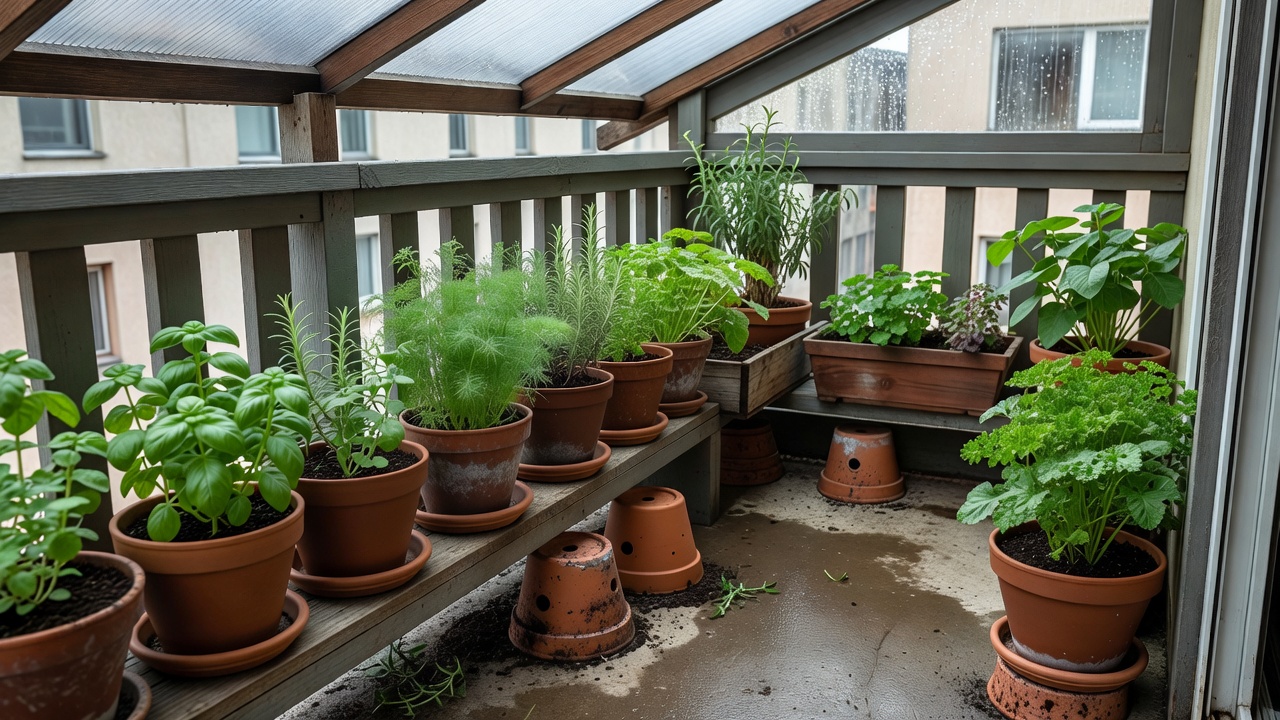
Read the container as a whole
Start with plant needs, pot size, growing medium, drainage and exposure. A sunlit terracotta pot behaves differently from a shaded plastic container. Roots also change the system as they grow. A watering rule that suited a young plant may become inadequate once its canopy and root mass increase.
Check that drainage holes are open and that runoff has somewhere appropriate to go. A deep saucer can become an unintended reservoir with roots sitting in stagnant water. On balconies, account for weight, safe placement and building rules; wet growing medium and stored water are not weightless. Keep containers and cables out of access routes.
Begin with an alert, not a pump
A useful first feedback loop can be entirely human-operated. Observe the pot at a consistent time, check the medium at a suitable depth and note how its weight changes after watering and drainage. Lift only containers you can handle safely. An electronic scale or load cell can track change, but growing plant mass, rain, objects on the pot and sensor drift complicate interpretation.
A moisture probe can add another perspective. Place it in representative medium with good contact, avoiding the container wall and the narrow wet path below a dripper. A single probe cannot prove that the whole root ball is evenly moist. Log its trend alongside your ordinary checks before allowing it to make decisions.
- Sense
- Weight trend, moisture trend, reservoir level
- Decide
- Does the plant need water now?
- Act
- Measured hand-watering or a limited dose
- Verify
- Drainage and root-zone response
Understand the reservoir before adding control
A self-watering planter generally uses a reservoir and a route for moisture to move into the growing medium. Performance depends on design, medium and plant suitability; “self-watering” does not mean every plant will tolerate it. Follow the planter’s filling and overflow instructions, and confirm that young roots can access moisture during establishment.
Check the reservoir directly rather than assuming an app knows its contents. Level indicators can stick, openings can clog and a sensor can fail in a convincing state. Keep stored water covered as the product design allows and avoid creating mosquito habitat. Follow local public-health guidance where standing water is a concern.
A reservoir also has an end. Calculate no holiday guarantee from its advertised volume alone. Actual duration depends on weather, plant growth, losses and the usable water remaining before the system stops delivering effectively. Test the arrangement while you are home and arrange a human check for valuable plants.
Add a small action with firm boundaries
If observation shows a genuine need, add a short, measured watering dose. Verify delivery into a container before aiming it at the plant. Tubing can kink, emitters can clog and small pumps can lose prime. Pump runtime alone does not prove that the expected volume arrived.
Use equipment designed for the job, with compatible low-voltage power and appropriate outdoor protection. Follow instructions about reservoir height, tubing and any required anti-siphon arrangement: some layouts can continue moving water after a pump stops. Keep the maximum available spill small enough that a failure cannot damage a neighboring property or electrical installation.
Require a fresh plausible reading before watering, cap the dose and wait before reassessing. A second limit on total watering prevents repeated small commands from becoming one large flood. Test an empty reservoir, disconnected probe and lost connection safely. A clear local indication is useful when a phone notification never arrives.
Keep maintenance in the picture
Inspect tubing, reservoir cleanliness and sensor position during ordinary plant care. Follow cleaning instructions and use materials suitable for the intended application. If growing edible plants, do not put unknown recycled containers or unsuitable treatment chemicals into the water path. Fertilizer residues and changing salts can affect both plant health and some sensor readings.
Separate a moisture question from a nutrition question. An electrical conductivity reading is not a complete diagnosis of nutrient balance, and leaf color alone is not a reliable prescription. Seek plant-specific horticultural guidance before adding dosing automation. A simple pot with a good medium and predictable drainage often needs less intervention than a connected system suggests.
Keep the result honest
Choose one container you can inspect easily. Record the existing routine, then add an alert while leaving watering manual. Compare missed checks, plant condition, false alarms and time spent charging, cleaning or reconnecting the device. If you later automate a dose, change that one part rather than replacing the entire setup at once.
You notice drying earlier without increasing saturation or spill risk.
The system needs more rescue than the old routine, or repeatedly disagrees with the root-zone condition.
A smart planter earns its place by making compact growing calmer. If the most useful discovery is that a larger pot and a regular check solve the problem, that is a successful experiment too.